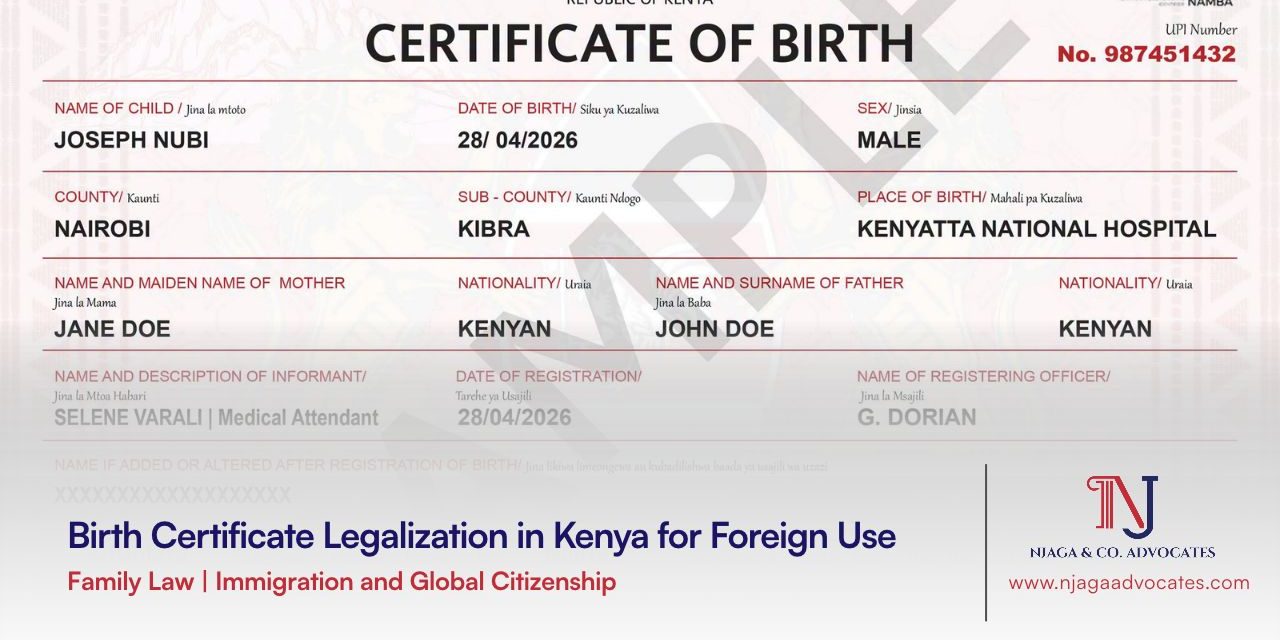
You may need a Kenyan birth certificate when applying for a foreign visa, sponsoring a dependent, getting married abroad, registering with an overseas civil registry, or proving a family relationship. However, the receiving authority may require more than the certificate itself: it may ask for birth certificate authentication, attestation, or legalization.
The correct procedure depends on where you will use the certificate and what the receiving institution requires. This guide explains what birth certificate legalization in Kenya involves, when you need it, why Kenya cannot issue an apostille, whether you need a new birth certificate first, the step-by-step process for authentication at the Ministry of Foreign Affairs and Diaspora Affairs, the estimated costs, and how our immigration team can handle the whole chain for you, even while you are abroad.
What is birth certificate legalization?
Birth certificate legalization is the official process of confirming that the signature, seal, or stamp on the birth certificate document is genuine. It helps a foreign authority rely on a document issued in another country. Legalization does not correct the certificate, establish citizenship, or conclusively prove that every statement in it is true. It only confirms that the proper Kenyan authority issued the document. A receiving authority may still verify the underlying birth record.
For a broader understanding of document legalization in Kenya, including personal, academic, and commercial documents, read our Comprehensive Guide to Legalizing or Authenticating Documents in Kenya.
When do I need to legalize a Kenyan birth certificate?
You may need birth certificate legalization for:
- Immigration, visas, and family reunification: proving the relationship between a parent and child for a dependent visa, residence application, or sponsorship.
- Marriage abroad: meeting a foreign marriage registry’s identity and civil-status requirements.
- Foreign civil registration: recording a birth, marriage, or family relationship with an overseas authority.
- Citizenship or nationality applications: supporting a claim involving parentage or descent.
- Employment: overseas recruitment, especially in the Gulf, where full attestation is often required.
- Education and relocation: satisfying a foreign institution’s requirements concerning age, identity or guardianship.
- Court, inheritance or estate matters: proving relationship to a deceased person or beneficiary in a foreign estate or pension claim.
Legalization is not automatically required for every foreign application. Obtain the receiving institution’s checklist before paying for certification, translation, or embassy services.
If you are preparing to marry overseas, also read our Guide to Certificates of No Impediment to Marriage in Kenya.
Why do we legalize documents in Kenya instead of applying for an apostille?
Kenya is not a Contracting Party to the Hague Convention Abolishing the Requirement of Legalisation for Foreign Public Documents 1961, commonly referred to as the Hague Apostille Convention (1961). Kenya therefore does not issue Convention apostilles for Kenyan public documents.
An apostille replaces traditional diplomatic or consular legalization where the Convention applies between the relevant countries. For Kenyan-issued birth certificates, applicants must obtain authentication by the Births Registrar, Notarization by a public notary, authentication by the Ministry of Foreign Affairs, and subsequent consular legalization by the Receiving country’s embassy in Kenya.
My destination country uses apostilles. Does that help me?
Not for a Kenyan document. The apostille system works only when both the issuing and receiving countries are parties. Because Kenya is not, a Kenyan birth certificate destined for an apostille country (for example, the Netherlands, the UK, or the USA) still goes through Kenyan authentication. The good news is that some of those countries accept the Kenyan Foreign Affairs Ministry’s authentication on its own.
The reverse also applies: a foreign birth certificate coming into Kenya cannot rely on an apostille alone and is usually legalized by the Kenyan embassy or high commission in the issuing country.
Anyone searching for “birth certificate apostille Kenya” should first identify the correct route for legalizing a Kenyan birth certificate.
What is the difference between authentication, notarization and legalization?
Although these terms sometimes overlap in practice, they describe different functions.
| Term | What it generally involves |
| Registrar authentication | Civil Registration Services verifies the birth certificate against the relevant issuing records or confirms its official issuance. |
| Notarization | A Notary Public performs an appropriate notarial act, such as certifying a copy after examining the original. |
| Foreign Affairs authentication | Kenya’s Ministry of Foreign and Diaspora Affairs (MFDA) authenticates the relevant official signature, seal, or certification. |
| Embassy or consular legalization | The destination country’s diplomatic mission provides further authentication if its procedures require it. |
| Translation | An accepted translator prepares the document in the language required by the receiving authority. |
Notarization alone does not necessarily complete the process. Equally, notarization and embassy legalization should not be treated as compulsory steps for every destination.
Do I need to apply for a new birth certificate before legalization?
In most cases, yes. Currently, the Registrar of Births certifies only birth certificates issued within the last 90 days. The Registrar’s certification confirms your certificate is a genuine record before the Ministry of Foreign Affairs authenticates it. If your certificate was issued more than 90 days ago, as is the case for almost everyone who obtained theirs as a child, you must first apply for a new birth certificate, then have it certified, notarized, and authenticated.
This is a Kenyan procedural requirement, not a question of whether your old certificate is still valid. Your existing certificate remains a lawful record, and some foreign authorities (the Netherlands, for example) treat a legalized Kenyan birth certificate as valid regardless of when it was issued. But to complete the Kenyan legalization chain, you will need a newly issued copy. Plan for this step in your timeline and budget.
Even within the 90-day window, a new or corrected certificate is also needed where the existing one:
- it is laminated. Laminated birth certificates are routinely refused: the Kenyan Embassy in Paris states expressly that it does not authenticate laminated birth certificates;
- it is torn, faded, water-damaged or illegible, including older handwritten certificates that cannot be read clearly;
- it contains errors, for example a misspelt name, a wrong date of birth, or missing or incorrect parent details. These must be corrected through an amendment application before authentication;
- it is lost, in which case you apply for a replacement (usually with a police abstract).
Some foreign authorities also set their own “recently issued” rule. A freshly issued certificate meets both the Registrar’s 90-day requirement and most of these.
How do I apply for a new birth certificate?
Applications are made online through the Department of Civil Registration Services on eCitizen (dcrs.ecitizen.go.ke). You select the relevant service (replacement, amendment, or current or late registration), upload the supporting documents, pay the fee, and track progress.
If you were born outside Kenya to Kenyan parents and your birth has never been registered in Kenya, start with our Guide on the Registration of Births of Kenyans Born Abroad.
What is the process for legalizing a birth certificate in Kenya?
- Step 1: Confirm what the destination requires. Ask the receiving authority (university, immigration office, registrar, or employer) exactly what it needs: Kenyan MFA authentication only, or embassy legalization as well; whether a sworn translation is required; and whether the certificate must have been issued recently. This one step prevents most wasted time and fees.
- Step 2: Review the Certificate, resolve discrepancies, and apply for a new birth certificate. Check the names, date and place of birth, parental details, and registration particulars against the supporting records. Check the certificate’s issue date. Unless your certificate was issued within the last 90 days, apply for a new one through Civil Registration Services on eCitizen, correcting any errors at the same time (see Part 3). Check that the new certificate is clean, legible, and correct before moving on.
- Step 3: Certification by the Registrar of Births. Present the newly issued certificate (within 90 days of issue) to the Registrar of Births for certification, confirming that it is a genuine entry in the birth register. This is the step the Ministry of Foreign and Diaspora Affairs (MFDA) relies on before it authenticates the document.
- Step 4: Complete notarization and notary validation if required. If the accepted route requires a notarized copy, a Kenyan Notary Public examines the original and performs the appropriate certification. Where authentication of the notary’s signature or status is required, the relevant Judiciary notarial certification must also be obtained. This is separate from the Registrar’s verification of the birth record.
- Step 5: Apply for authentication on eCitizen. Log in to ecitizen.go.ke with your eCitizen account, choose Birth & Death Certificate or notarized documents, complete the form, upload a clear scan of the certified certificate and your ID or passport, and pay the invoice.
- Step 6: Ministry verification and digital authentication. The M FDA verifies the certificate with the issuing registry and issues the authentication. Under the electronic model introduced in December 2023, the certificate is a digital document (PDF) with a QR code that the receiving authority can verify online. The Ministry’s published guidance indicates processing of about two to three working days for complete applications.
- Step 7: Obtain embassy or consular legalization where required. Some destinations require further endorsement by their embassy, high commission, or consulate. Others accept Kenyan Foreign Affairs authentication without that additional step. Check whether the destination also requires an additional step after the document arrives there.
- Step 8: Translate, if required. Countries such as France, Germany, Italy, Spain, and many Gulf states usually require a certified or sworn translation. Some require the translation itself to be legalized, so confirm the order of steps first.
- Step 9: Final step in the destination country, if required. Some countries, particularly in the Gulf, add a final attestation by their own foreign ministry once the document arrives. This is done in that country, not in Kenya.
Can I arrange birth certificate legalization while living abroad?
Yes, you can often instruct an advocate or authorized representative to handle the Kenyan stages while you remain overseas, provided the relevant offices accept representation.
Start by providing a clear scan of your identification, the destination country, and the receiving authority’s checklist. The original may still be required for Registrar authentication, notarial examination, or consular submission.
Confirm the applicable requirements before sending an original certificate by international courier.
How long does the process take?
| Stage | Typical time |
| New birth certificate | Varies; allow 1-2 weeks, longer for corrections and applications from abroad |
| Certification by the Registrar of Births | 3-5 days, subject to the Registrar’s availability. |
| MFA authentication on eCitizen | About 2 to 3 working days for complete applications |
| Notarization by a Public Notary | 1-7 hours, allowing time for the Judiciary to issue the notarial attestation certificate. |
| Translation (if needed) | Usually, 1 to 5 working days |
| Embassy legalization (if needed) | Set by each embassy; commonly several working days to two weeks, plus appointment waiting time |
| International courier (if you are abroad) | Usually, 2 to 7 working days |
What are the estimated costs of legalizing a birth certificate in Kenya?
The total depends on the required stages. Government fees, professional service charges, and embassy fees are separate items.
For matters requiring notarization and assistance with Foreign Affairs processing, our indicative service budget is KES 20,000 per document, comprising KES 7,000 for notarization and KES 13,000 for Foreign Affairs processing.
| Item | Estimated cost | Notes |
| New birth certificate (applied for so it is within the 90-day window) | About KSh 3,000 | Approximate all-in cost of applying for and obtaining the new certificate |
| Certification by the Registrar of Births | About KSh 3,000 | Approximate costs and registry disbursements for the Registrar’s certification |
| Notarization by a public Notary | About KShs 5,000- KShs 10,000 | The cost includes the national stamp/seal and the subsequent application for the notary’s attestation certificate from the judiciary. |
| MFA authentication | KSh 700 per certificate exclusive of the related disbursements | Per the Ministry’s published schedule; the exact amount is shown on the eCitizen invoice |
| Corrections/amendments (if needed) | Additional | Huduma Kenya quotes a KSh 1,000 government fee for applications with corrections |
| Certified translation | Varies | Quoted per page by the translator; required by many non-English-speaking countries |
| Embassy legalization | Varies by embassy | Set by each embassy and often payable in foreign currency; check the embassy’s consular fee schedule |
| Courier (if abroad) | Varies | Depends on destination and service |
These figures are estimates and change from time to time. Our professional fee depends on the steps your file needs and is quoted in advance after a document review.
Frequently asked questions about birth certificate legalization in Kenya
Q: Can I legalize my Kenyan birth certificate while living abroad?
A: Yes. You can legalize your birth certificate remotely by appointing an advocate or agent to assist you, so you can start the process from anywhere. Where an embassy step-in in Nairobi or a replacement certificate is needed, you can appoint an advocate to act for you under a letter of authority or power of attorney or use the consular services of the Kenyan embassy in your country.
Q: Can an advocate handle the whole process for me?
A: Yes. We regularly manage the full chain, from replacement certificates and verification by the Births Registrar to notarization, MFDA authentication, translation, embassy appointments, and courier delivery abroad.
Q: Can Kenya issue an apostille on my birth certificate?
A: No. Kenya is not a party to the Hague Apostille Convention, so Kenyan authorities cannot issue apostilles. The equivalent route is certification by the Birst Registrar, Notarization by a Public notary, and MFDA authentication, plus, where required, embassy legalization.
Q: Can I use the birth certificate I got as a child?
A: Not for legalization. The Registrar of Births only certifies certificates issued within the last 90 days, so you will need to apply for a new one first. Your old certificate remains a valid record for other purposes.
Q: Do I need a translation if my certificate is in English?
A: That depends on the destination. For example, the Netherlands’ guidance accepts English documents without translation, while other authorities, particularly those that don’t use English as their official language, may require a translation into their official language.
Disclaimer: This article provides general information and does not substitute legal advice on the specific circumstances of any individual or organization. Fees, embassy requirements, and procedures change frequently. While the information is accurate as of the date of publication, we cannot guarantee that it remains accurate at the time you read it. Before acting on any of this information, please seek professional legal advice tailored to your situation.